

A WhatsApp conversation landing on the customer card means that a conversation on the business number is tied to the writer's record in the CRM. The conversation then sits in the company's record rather than on a salesperson's phone.
01.How is a WhatsApp conversation tied to the customer card?
In Corex360 a WhatsApp conversation is tied to the person and kept on the customer card; because messages, calls and email link to the same person, the date of the last contact is clear.
Example scenario: Picture a kitchen showroom in Eskişehir. One evening a customer asks on WhatsApp for the price of a worktop. If the customer is registered, the conversation sits on the card that holds last month's measuring visit and the first quote that was sent; the next morning the salesperson sees on one screen who wrote, what they asked, and whether there was any earlier contact.
The keys to matching are the phone number and the e-mail address. If the same person writes on WhatsApp one day and by e-mail the next, and both details are on the same card, the conversations come together on that card. The technical side, how a business number connects to software, is covered in what the WhatsApp Business API is.
For matching to work well, the cards need to be clean. If the same customer has been opened twice, the conversation lands on one of them and does not show on the other. We move your existing customer records into Corex360 together with you.
02.Why should the conversation not stay on the salesperson's phone?
A conversation on a phone leaves with the salesperson; a conversation on the record stays with the company when the salesperson changes, and whoever takes over picks up where it stopped.
The salesperson goes on leave or leaves the company. The customer keeps writing to the same number, but that number is now in someone else's pocket, or in nobody's. The new salesperson has to ask the customer what they discussed before. For the customer, that means explaining everything from the start.
Selling from a personal phone also has a visibility problem. The manager does not know which customer is waiting for an answer and finds out only when the customer complains. Once the conversation is on the record, an unanswered message lands on a list everyone can see.
The point of putting the conversation on the record is to look after the customer; the record also safeguards the salesperson's work. Customers believe they are talking to the company, not to one person; the information they give, the photos they send, and the promises they receive should stay with the company. It makes a difference for the salesperson too: when they go on leave, they know their customers will not be left unanswered.
03.How does a price question turn into an opportunity and a quote?
A price question opens an opportunity on the card; the quote is prepared on the same card, sent once approved, followed up if no reply comes; the quote and the contract sit on the same customer card.
Most price questions that arrive on WhatsApp never make it onto a list. Some get an answer, some are forgotten in the evening rush. At month end there is no answer to 'which quotes did we hear back on', because the price question was never recorded. On the card, the flow runs in this order:
- The price question becomes an opportunity; its stage and owner sit on the card.
- The quote is prepared on the card and sits in the card's Quotes tab.
- If no reply comes, a reminder rises to the top of the list; it is sent on approval.
- If the customer approves by phone, the call record lands on the same card.
- The contract sits on the same customer card as the quote; its start and end dates show on the contract card too.
WhatsApp stops being a chat window and becomes the first step of the sales process. The manager can also see from the cards which question became a quote and which is still waiting, without asking the salesperson for a report. Because the quote is prepared on the same card, sent once approved, and followed up with a reminder if no reply comes, no step of the flow moves into a separate file.
04.What changes when Instagram, e-mail, and calls land on the same card?
When the channels land on the same card, the customer appears as one person whatever the channel; every contact sits on one timeline, and the latest contact is clear.
The same customer asks for a catalogue on Instagram in the morning, sends a photo on WhatsApp at noon, and rings the switchboard in the evening. Three channels often mean three different people and three half-stories. Nobody sees the whole picture, and the customer tells the same thing three times. When the channels are gathered in one inbox, the team looks at one list. Every conversation is assigned to an owner, and anything unanswered comes to the top. How several people write from one number, and how assignment and manager visibility are set up, is covered in detail in WhatsApp for teams.
Knowing the latest contact looks like a small detail, but it sets the direction of a sale. If the customer called last night, the note on that call is read before a price reminder goes out on WhatsApp in the morning. The card does not tell the salesperson what to say; it shows what has already been said.
05.How does Corex360 handle a WhatsApp conversation?
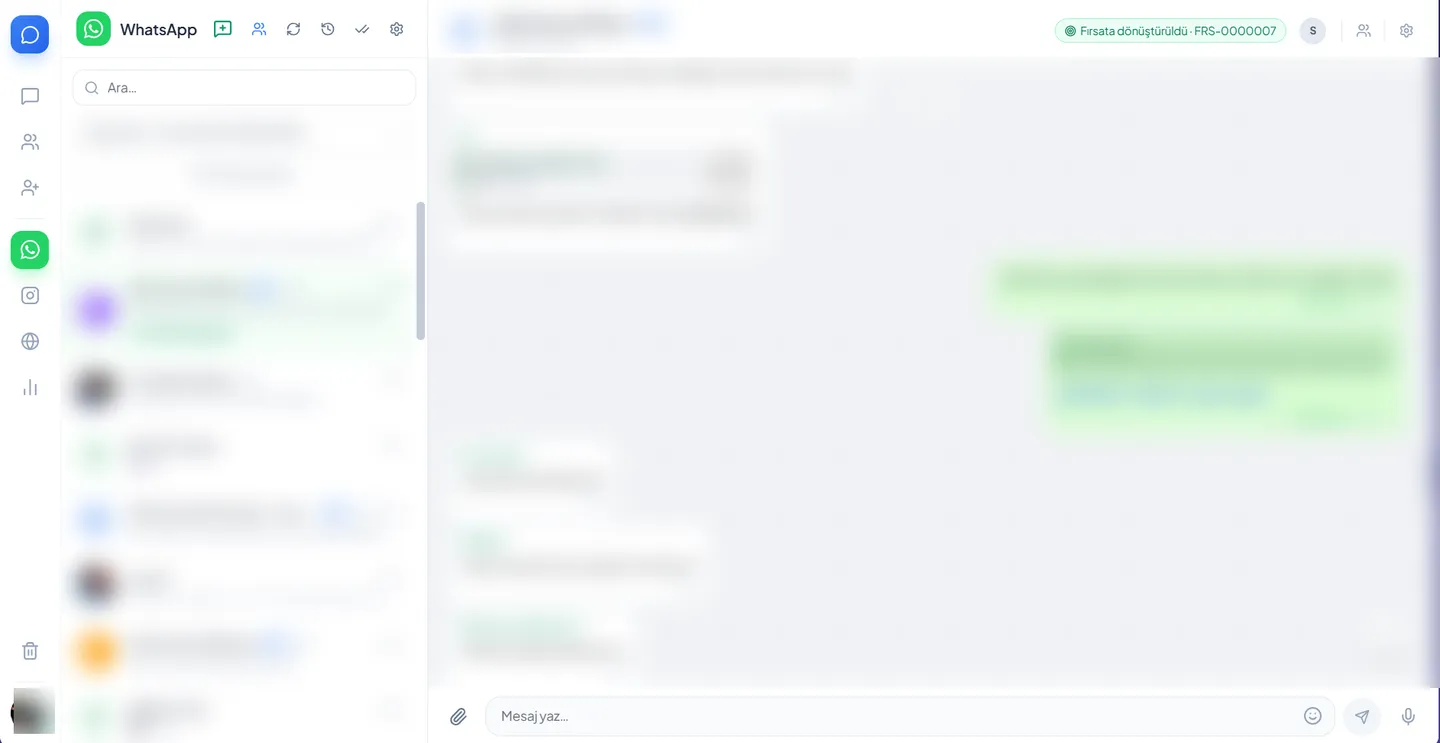
In Corex360 your WhatsApp line connects as a channel; the conversation is assigned to an owner, and the thread is converted into an opportunity that carries its opportunity number.
In Corex360, WhatsApp, Instagram, and website messages are gathered in one inbox. Company email and phone calls link to the same person. You can see step by step how the channels come together on Messaging module page. The current rules for businesses using WhatsApp through software are in Meta's WhatsApp Business Platform developer documentation.
The conversation is assigned to an owner, and the Assigned to me filter above the list lets everyone pick out their own conversations. A thread converted into an opportunity carries the opportunity number badge in the list and in its header; if a quote that came out of it gets no reply, X AI follows the quote up. It does not send a reply or a quote to a customer on its own; it prepares a draft, and sending happens with your approval. Because the story sits on the card, whoever takes over the conversation carries on from where it stopped.
Messages are stored in the Corex360 core, on the customer card, either on Corex360 Cloud or on your own server. Access is role-based and logged, and personal data is processed under KVKK (the Turkish Personal Data Protection Law).
06.Who does not need to tie WhatsApp to a record?
In a small business where one person speaks to customers and a price question turns straight into a sale, the phone is usually enough; and for anyone after bulk campaign messaging, this set-up is not the right answer.
For someone running a neighbourhood shop on their own, tying WhatsApp to a record can be extra work; the conversation already sits with the owner, and the owner does not change. The need for a record arises as the sales team grows, when several people start writing from the same number, or when the quote and contract process gets longer.
Before tying WhatsApp to the record, agree one rule with the team: which number will business conversations run on? If salespeople keep messaging customers from personal numbers, no system can see the whole picture. Moving conversations to the company number is a decision to make before the software.
Let us also state a limit plainly: we do not promise bulk messaging, campaign sending, or an automatic reply bot for Corex360 Messaging. In the demo we open a conversation with your own WhatsApp number and watch together how the card is created and how the price question turns into a quote.
Sources
- Meta for Developers, WhatsApp Business Platform Last checked
How was this page prepared?
- Written by: Şevket Erer, Co-founder, AI Specialist
- Sources: official body, standard, and vendor information is taken from the primary sources in the Sources list on this page; each source shows the date it was last checked.
- Product information: sentences about Corex360 rest on the company's product fact records; unconfirmed features are not written.
- Use of AI: the Corex360 team writes the text; AI tools are used for drafting and translation. Publishing principles
- Dates: first published , last updated . Corrections policy
Frequently asked
01What are the ways to connect WhatsApp to a CRM?
Businesses usually use one of a few routes: copying conversations by hand, keeping the WhatsApp Business app on a shared phone, or connecting the business number to software through the WhatsApp Business API. Which one fits depends on message volume and team size; the API is covered in detail in our article on what the WhatsApp Business API is.
02How is WhatsApp connected to the CRM?
Your WhatsApp line connects to Corex360 as a channel. Conversations land on the customer card and stay on record.
03What is the difference between a shared inbox and a conversation tied to the CRM?
A shared inbox lets the team see messages sent to one number on a single list. A conversation tied to the CRM goes a step further and links the conversation to the customer record, the opportunity, and the quote. The inbox shows who will answer; the card shows what the conversation turned into. How a team shares one number is the subject of our article on WhatsApp for teams.
04How is a WhatsApp conversation kept on the customer card?
The conversation sits on the writer's customer card in date order, on the same timeline as contacts from the other channels. The opportunity it is linked to and the quote that came out of that opportunity appear on the same card, and the latest contact can be read at a glance.
05What happens if the same customer writes from different numbers?
A message from a number that is not on file starts a new card.
06Who can see WhatsApp messages?
Only those with permission. In Corex360 messages are stored on the customer card, access is role-based, and every access is logged. Personal data is processed under KVKK (the Turkish Personal Data Protection Law), and setup runs on Corex360 Cloud or on your own server.
WhatsApp, Instagram, and web chat gather in one inbox; the WhatsApp line connects through Meta's official cloud API.
Related articles
Keep reading.

The WhatsApp Business API lets messages flow through software instead of the phone app. Connecting a number and template rules work differently from the app.
DateRead the article01MessagingWhatsApp for teams: how several people write from one number
WhatsApp for teams means several people answering one business number from a shared inbox. Each message gets an owner, and unanswered ones come forward.
DateRead the article02MessagingHow to manage Instagram DMs as a team: inbox, assignment, and record
Instagram DM management gathers business messages in a shared inbox, assigns an owner, and links them to the customer record. Account type and requests.
DateRead the article03MessagingWhatsApp Business app or API: which one suits you
The WhatsApp Business app suits a number one person looks after, the API a number a team shares; the time to move comes before your busiest season begins.
DateRead the article04Cloud PBXHow a caller is matched to the customer card: linking the phone to customer records
PBX and CRM integration matches the caller's number to a customer card and logs the call. An unmatched number and a missed call each need an owner as well.
DateRead the article05Cloud PBXHow to choose a cloud PBX: lines, features, and the customer record
Choosing a cloud PBX means reading the offer beyond lines and minutes. Draw your call flow first, use the trial period well, and read the exit terms.
DateRead the article06EmailWhat is CRM email integration: how correspondence links to the customer record
CRM email integration links correspondence to customer and opportunity records. Connection methods, address matching, emails to keep out, and access.
DateRead the article07EmailWhat is a shared mailbox, and how it differs from a personal one
A shared mailbox is the team's memory; a personal one is one employee's. Mail sent to sales@ needs an owner, and the record changes what happens next.
DateRead the article08