
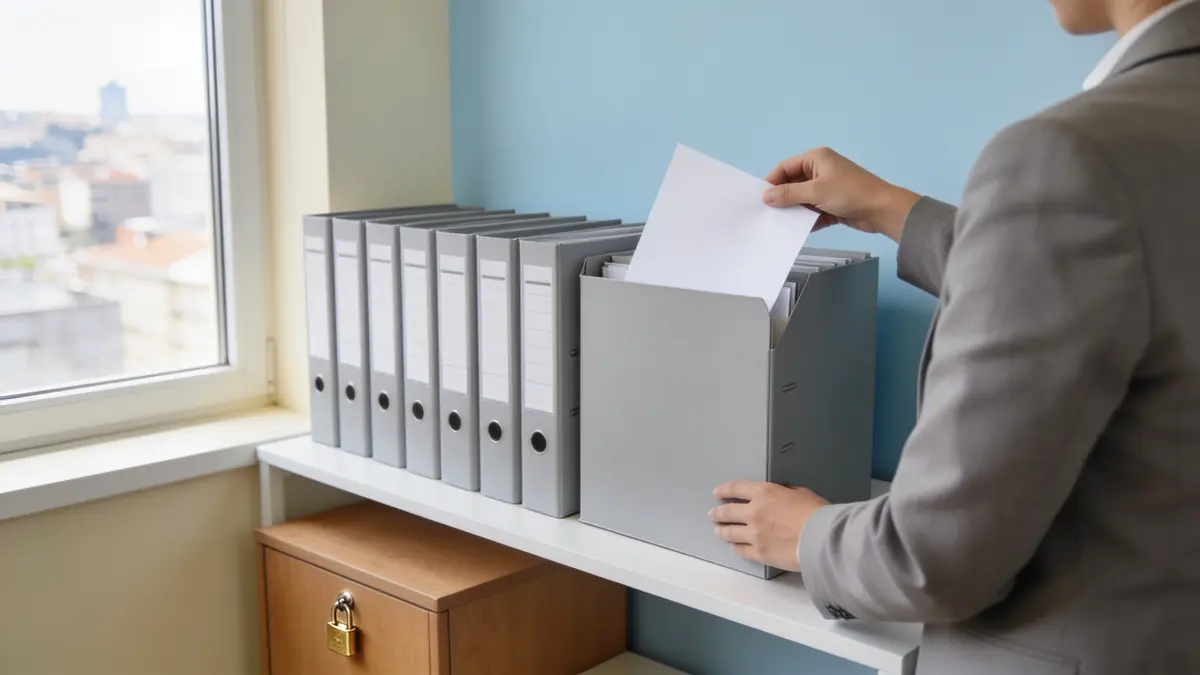
A personnel file is the file an employer draws up for each employee, keeping the employee's identity details together with the documents and records the law requires. Turkey's Labour Law sets this file as an obligation on the employer and requires it to be shown to the competent officials and authorities on request. Whether the file is a paper folder or a digital record does not change the obligation; what changes is who reaches a document, and when.
01.Why is a personnel file kept?
A personnel file does two jobs: it meets the employer's legal duty to keep documents, and it ensures that when a question about an employee comes up, the answer is in one place.
The wording of the law is brief. The employer keeps in this file, together with the employee's identity details, every document and record it is required to draw up under the law. The same provision places a second duty on the employer: to use what it learns about the employee honestly and lawfully, and not to disclose information the employee has a legitimate interest in keeping private. The current text of the law can be read in the Legislation Information System.
Example scenario: picture a furniture workshop in Kayseri. The file is requested during an inspection or when an employee leaves. If the documents are spread between the accounts cupboard, the workshop manager's drawer, and the HR officer's email, the answer takes days, and a missing document is noticed only on that day.
The file protects the employee as well. Length of service, training received, and leave history are also the employee's evidence in a disagreement. A well-kept file takes an argument such as 'I did that training' or 'I never used that leave' out of guesswork and ties it to the record.
02.What documents does a personnel file hold?
A personnel file holds identity details, the employment contract, the social security start notice, diplomas and certificates, medical reports, training, leave, and asset assignment records, and the documents drawn up on leaving; the list grows with the type of work.
This list, from identity details to leaving documents, is a starting point for most workplaces; other documents required by law are added depending on the nature of the work. Confirm with your accountant or employment law adviser which documents are mandatory for your workplace.
- Identity and contact details.
- The employment contract, with any annexes and amendments.
- The employment start notice to SGK (Turkish social security).
- Diplomas, certificates, and vocational qualification documents.
- Pre-employment and periodic medical reports.
- Occupational health and safety training records.
- Annual leave records and leave requests.
- Asset assignment records.
- Documents drawn up when the employee leaves.
As the list grows, the names of document types start to matter. If the same document is saved as 'medical report' for one employee, 'report' for another, and 'document' for a third, search stops working. In a digital system, document types are defined in advance and every document is tied to a type. A missing document for an employee then shows in the type list without opening each file one by one.
03.How are sensitive documents such as medical reports protected?
Health data counts as special category personal data under KVKK (Turkey's personal data protection law); only people who need a medical report in the personnel file for their job should be able to reach it, and every access should be logged.
The most sensitive part of a personnel file is its health documents. Turkey's Personal Data Protection Law lists health data among special categories of personal data and subjects its processing to stricter conditions. The guides page of the Personal Data Protection Authority lists a separate guide on processing special categories of personal data.
In a paper file, the medical report sits in the same folder as the ID and the contract, and whoever opens the folder sees all of them. In a digital system, health documents can be kept as a separate type with narrower access: the person preparing payroll sees the contract but not the medical report. This section is general information; consult your legal adviser about your own workplace.
04.How do you set up a digital personnel file?
First the document types and who can reach each type are written down, then existing paper documents are scanned and linked to each employee's record by type; new documents enter the record through the work itself, for example through a leave approval.
Going digital starts with rules, and scanning comes after. The document types, who each type is open to, the file naming format, and when a document gets updated are written down first. Whether a scanned copy can stand in for the original is a separate question; decide with your legal adviser whether originals with wet signatures should be kept.
At the Kayseri workshop this could work as follows: when a new starter's contract is signed, it is scanned and linked to their record as an 'employment contract'. When a leave request is approved, the approval record stays in the file; how leave is tracked on the record is set out in leave tracking. A tool handed over as an assigned asset is entered on the staff record with its handover form. You can see what an asset assignment record covers in the asset assignment tracking entry.
A file is not set up once and left. A document goes out of date when a medical report is due for renewal, a certificate expires, or a training course is due to be repeated. In a digital system these dates are written with the document and upcoming renewals land on a list; in a paper folder, an out-of-date document is often noticed only on the day of an inspection.
05.What happens to the personnel file when an employee leaves?
When an employee leaves, the file is not deleted straight away; it is kept with narrower access for as long as the law and possible disputes require, and when that time is up it is erased, destroyed, or anonymised according to the rule.
A former employee's file is still useful: it may be requested for a certificate of service, an inspection, or a lawsuit. On the other hand, keeping personal data longer than needed also causes problems under KVKK. That is why the retention period is set per document type, and when it expires the record is erased, destroyed, or anonymised.
How long each document is kept depends on the relevant legislation and the nature of the work, so no periods are given here. Draw up the retention table with your accountant and legal adviser. In a digital system each document type carries its period, and documents whose time is up appear on a list without relying on anyone's memory.
06.Where do staff documents sit in Corex360?
Corex360's Human Resources screens hold the staff record, document types the company defines itself, leave and advance requests, and asset and assignment records; access is role-based.
Alongside the staff, attendance, and leave calendar screens, the Human Resources module has document type definitions, so the company defines its own document types. Leave, advance, travel expense, and payment requests are raised in the product and go through an approval flow. Asset and assignment records are in the same module, and assignments sit on the staff card. The Corex360 Human Resources page shows the module's screens.
Files are kept encrypted and permission-bound in Corex Drive; the same file appears to each department with its own permissions, and every view and download is logged. Personal data is processed under KVKK (Turkey's personal data protection law). Which document types to open and who can reach sensitive documents are set at setup, using your own workplace's list.
Sources
- Legislation Information System, Labour Law No. 4857 (current text) Last checked
- Personal Data Protection Authority, Guides Last checked
How was this page prepared?
- Written by: Şevket Erer, Co-founder, AI Specialist
- Sources: legislation, official body, and vendor information is taken from the primary sources in the Sources list on this page; each source shows the date it was last checked.
- Product information: sentences about Corex360 rest on the company's product fact records; unconfirmed features are not written.
- Use of AI: the Corex360 team writes the text; AI tools are used for drafting and translation. Publishing principles
- Dates: first published . Corrections policy
Frequently asked
01What is a personnel file?
A personnel file is the file an employer draws up for each employee, keeping identity details together with the documents and records the law requires.
02Is keeping a personnel file mandatory?
Yes. Turkey's Labour Law requires the employer to draw up a personnel file for every employee and to show it to the competent officials and authorities on request.
03Can a personnel file be kept digitally?
Keeping the file digitally is common. Whether a scanned copy is enough for a given document, and whether originals with wet signatures must be kept, depends on the document type; make this decision with your legal adviser.
04Can an employee see their own personnel file?
KVKK gives people the right to learn whether personal data about them is being processed and, if so, to request information about it. How the company answers an employee's request should be written into company policy.
05Who should be able to access a personnel file?
Those who need it for their job: the HR officer, the person preparing payroll, and the employee's manager when necessary. Access to special categories of data, such as health documents, is kept narrower still.
06Where does an asset assignment record sit in Corex360?
Corex360's Human Resources module has asset and assignment screens, and the assignment sits on the staff card.
Leave, advance, and overtime requests land in the approval centre; the manager approves or rejects them, and the record keeps who approved and when.
Related articles
Keep reading.

Time and attendance records clock-in and clock-out times and feeds leave, overtime, and payroll. That data falls under KVKK (Turkish data law).
DateRead the article01HRHow to track leave and prevent calendar clashes
Leave tracking keeps requests, approvals, balances, and the team calendar together. Two engineers should not book the same week, and leave ties to attendance.
DateRead the article02HRHow to make a performance review fair: let the score come from the work
In a fair performance review the score comes from the record and the rule is known in advance. Rules written down early keep the review meeting calm.
DateRead the article03HRHow to choose a time and attendance system: look at the record before the device
Choosing time and attendance: card, PIN, or phone comes after the month-end desk. KVKK (Turkish data law) and how your workplace runs decide the rest.
DateRead the article04HRLeave tracking: paper forms or a digital flow
A paper leave form works for a team in one building with one approver. Once the team spreads out, it is time to move leave to a digital flow.
DateRead the article05HRHow to calculate overtime: hours, pay, and time off in lieu
Overtime is calculated by finding the hours above the weekly limit and paying them at the higher rate or as time off. Thresholds, rates, consent, limits.
DateRead the article06HR & AttendanceAttendance problems: late arrivals, missing records, and leave clashes
Most attendance problems come from clock-in records kept apart from tasks and leave. The root causes of late arrivals, missing records, and leave clashes.
DateRead the article07MessagingWhat is the WhatsApp Business API, and how do you connect a business number?
The WhatsApp Business API lets messages flow through software instead of the phone app. Connecting a number and template rules work differently from the app.
DateRead the article08