
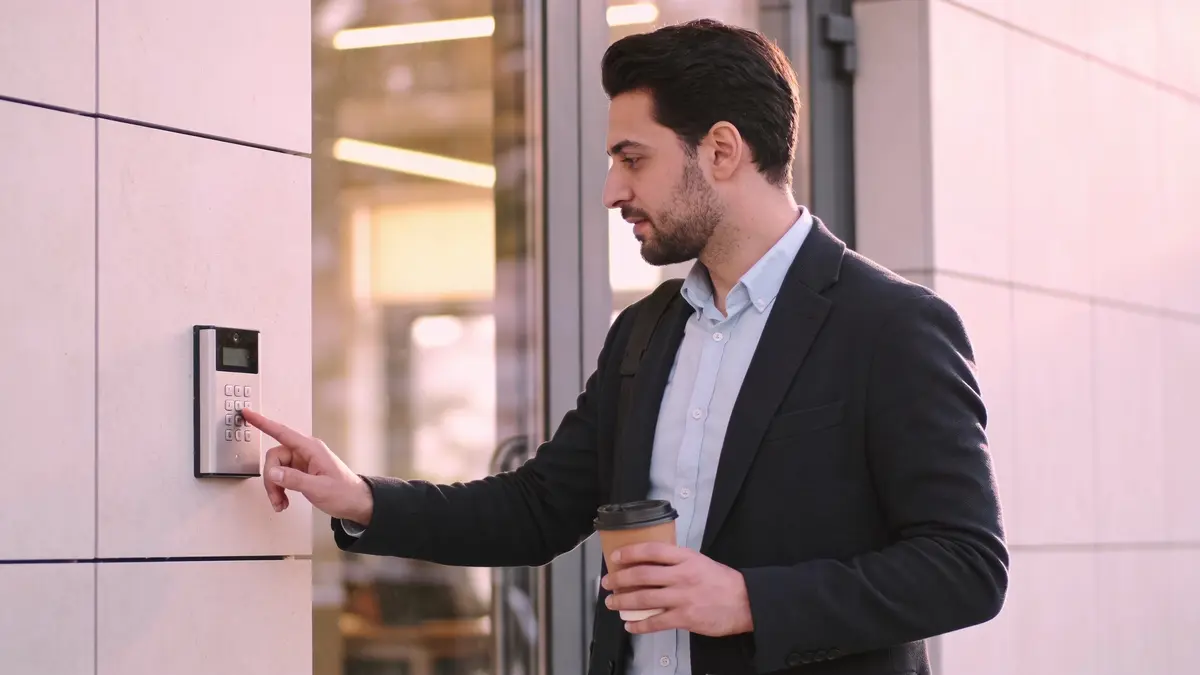
Time and attendance, known in Turkey as PDKS, is a system that records when employees clock in and out using a card, a PIN, or a mobile app, and feeds that record into overtime, leave, and payroll. The device is the visible part; the real work is turning the record into a correct payroll at month end.
01.What is a time and attendance system made of?
A time and attendance system is made of a reader, software that collects the records, and a work calendar that gives them meaning.
| Part | What it does |
|---|---|
| Reader | Takes the clock-in by card, PIN, or phone |
| Record | Who, which day, what time, which door |
| Work calendar | Shifts, start times, breaks, and holidays |
| Staff card | The person the record belongs to, their department and manager |
| Approval | Whose approval corrects a missing or wrong record |
A biometric reader is considered disproportionate for tracking working hours under a Personal Data Protection Board decision; when choosing a reader, cards, PINs, or phone clock-in come first. Each of these parts can come from a different vendor. The device at the door is from one company, the software that reads it from another, and the payroll program from yet another. Problems usually appear in the gaps between the parts.
In a small office these parts may be no more than a card reader and an Excel file. In a plant running shifts, the work calendar is a job in itself; shift changes, weekend work, and public holidays are each defined separately.
02.What does a clock-in record say on its own?
A raw record is only a person and a time; it gains meaning when it is placed next to the shift, the leave, and the assignment.
Example scenario: Picture a factory in Gebze running shifts. An operator on the night shift clocks out before dawn. The record falls on the next day. If the calendar does not know the shift, this person looks as if they never left one day and never arrived the next.
The same happens on a day of leave, an off-site assignment, or a training day. The device sees only who passes the door; it does not know why someone did not. Other records tell the reason: the leave request, the assignment, the shift plan. At the Gebze plant, the person who interprets the raw record is usually the shift supervisor. The supervisor knows who works on which line; the system does not. Until what the supervisor knows is written into the calendar, the same corrections are made by hand every month.
03.How does clock-in data connect to leave?
When the leave record and the attendance record meet on the same staff card and calendar, a day of leave is not counted as an absence.
In most companies leave runs separately: a form, an email, sometimes a WhatsApp message. The attendance system sees nobody that day and records an absence. At month end HR puts the two lists side by side and fixes them by hand. The person making the fix is usually not the one who approved the leave, so later nobody knows why a given day was changed.
In Corex360 a leave request goes through an approval flow in the HR module, and the approval is logged with who gave it and when. The attendance device is tied to the same core, so clock-in records land on the same staff card.
When leave and attendance meet, the manager's job gets easier too. Looking at who has not arrived in the morning, they see in the same list who is on leave and who is on an off-site assignment; whatever gap remains is a record that really needs an explanation.
04.How does the data flow into payroll?
What goes to payroll is not raw hours; it is approved working days, overtime, leave, and advances.
A payroll calculation is more than a sum of hours. Overtime has to be approved, the type of leave has to be known, advances have to be deducted. If this information sits in different places, payroll day turns into a day of stitching lists together.
At the Gebze plant, payroll day goes like this: the attendance export is pulled, compared with the leave list, overtime approvals are gathered from emails, and advances are added from a separate spreadsheet. Every step is a copy, and every copy is a chance for error. The mistake is noticed not in payroll but in the wage that reaches the employee's account, and that is where it hurts trust.
The software that carries this flow is usually sold as a time and attendance program, but the deciding question is how well it talks to payroll, not to the device at the door. In Corex360 clock-in records land on the staff card. We covered day-to-day issues such as missing records and late clock-ins separately in common time and attendance problems.
05.How is attendance data protected under KVKK (Turkish data protection law)?
A clock-in record is personal data; under the Personal Data Protection Board principle decision 2026/921, fingerprints and face recognition are not used for tracking working hours, and methods such as a card or PIN are chosen instead.
In its principle decision 2026/921 of 29 April 2026, the Personal Data Protection Board stated that processing biometric data to track working hours does not meet the principle of proportionality, even with the employee's explicit consent. The Board points to less intrusive methods such as a card, a PIN, an RFID or NFC ID card, and a signature sheet. Choose your clock-in method in light of this decision together with your legal adviser.
Retention is a decision too. How long attendance records are kept, what happens to them when an employee leaves, who can see the backups; the answers should be written down before the system is set up. An answer given afterwards usually comes after a complaint.
In Corex360 access to attendance and payroll data is role-based and logged, and personal data is processed under KVKK (Turkey's personal data protection law). If corporate policy does not allow the cloud, the installation runs on your own server. Detailed HR and attendance questions are answered separately in the site's FAQ section.
06.What should you look for when choosing a system?
Before the device, look at where the record goes: does it sit with leave, overtime, and payroll, or is it joined by hand at month end?
The choice turns on compatibility with the existing device, shift rules, how early a missing record is caught, and access to personal data; in Corex360 the attendance device connects to the core and clock-ins build up on the employee's card. You can read about reader types, KVKK (Turkish data protection) notes, and setups per workplace in the time and attendance buying guide.
07.What does the demo show?
The demo shows how a clock-in from your own device reaches the staff card and leave.
The attendance device connects to the Corex360 core, and the clock-in and clock-out record lands on the employee card. A leave request passes through the approval flow in the HR module; the approval is recorded with who gave it and when, and approved leave sits on the same card as the attendance record. Access to attendance and payroll data is role-based and logged; if your corporate policy does not allow the cloud, the system is installed on your own server.
08.How does an attendance event come up for approval in Corex360?
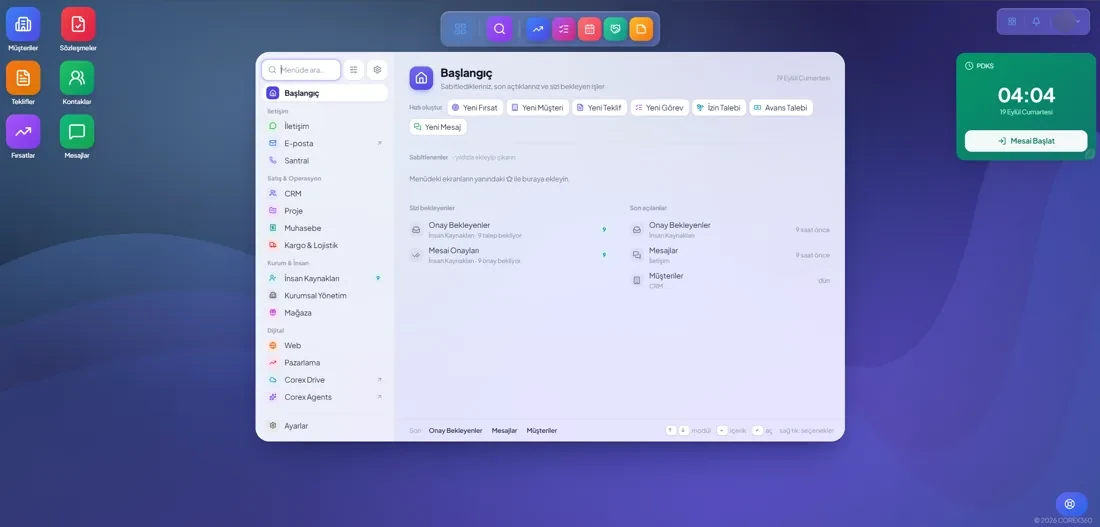
In Corex360 attendance events land in the approval center of the HR module, where the manager approves or rejects them.
The events that come up for approval are a shift not ended that the system closed at the shift time, a late clock-in, a clock-out away from the location, and a late clock-out, that is, overtime. The record shows the employee's explanation and department. Under the PDKS heading there are screens for shift management, overtime tracking, attendance tracking, timesheets and the leave calendar. Salary calculation and official filings are not promised.
Sources
How was this page prepared?
- Written by: Şevket Erer, Co-founder, AI Specialist
- Sources: legislation, official body, and vendor information is taken from the primary sources in the Sources list on this page; each source shows the date it was last checked.
- Product information: sentences about Corex360 rest on the company's product fact records; unconfirmed features are not written.
- Use of AI: the Corex360 team writes the text; AI tools are used for drafting and translation. Publishing principles
- Dates: first published , last updated . Corrections policy
Frequently asked
01What is time and attendance (PDKS)?
PDKS is the Turkish abbreviation for a staff attendance control system, known in English as time and attendance. It records employees' clock-in and clock-out times with a device or app and passes that data to overtime, leave, and payroll.
02Is using a time and attendance system a legal requirement?
No general legal rule requires an attendance device; employers are expected to keep records of working time such as overtime. Settle the recording method and how records are kept with your accountant or legal adviser for your own situation.
03What is mobile time and attendance, and when is it used?
Mobile time and attendance means clocking in from an app on the phone. It suits field teams without a fixed door, construction sites, and staff working across branches. If extra data such as location is processed with the record, employees should be told clearly.
04Card or fingerprint for tracking working hours?
Use methods such as a card, a PIN, or an ID card. Under the Personal Data Protection Board principle decision 2026/921, biometric methods are not considered proportionate for time tracking even with explicit consent; reader types are compared in the time and attendance buying guide.
05How long should attendance records be kept?
Giving a single period would be misleading. The retention period depends on obligations under employment law, personnel file rules, and the purpose limitation principle in KVKK. Settle the period with your legal adviser and write it into the company's retention policy.
06Are assigned assets kept on the staff card too?
Yes. In the Corex360 Human Resources module assigned assets sit on the staff card. That way attendance, leave, and assets appear on the same card.
Leave, advance, and overtime requests land in the approval centre; the manager approves or rejects them, and the record keeps who approved and when.
Related articles
Keep reading.

Leave tracking keeps requests, approvals, balances, and the team calendar together. Two engineers should not book the same week, and leave ties to attendance.
DateRead the article01HRHow to choose a time and attendance system: look at the record before the device
Choosing time and attendance: card, PIN, or phone comes after the month-end desk. KVKK (Turkish data law) and how your workplace runs decide the rest.
DateRead the article02HRLeave tracking: paper forms or a digital flow
A paper leave form works for a team in one building with one approver. Once the team spreads out, it is time to move leave to a digital flow.
DateRead the article03HRWhat is a personnel file, and how do you keep one digitally
A personnel file is the record an employer keeps for each employee. The documents it holds, health data, access rights, and rules for keeping it digitally.
DateRead the article04HRHow to make a performance review fair: let the score come from the work
In a fair performance review the score comes from the record and the rule is known in advance. Rules written down early keep the review meeting calm.
DateRead the article05HRHow to calculate overtime: hours, pay, and time off in lieu
Overtime is calculated by finding the hours above the weekly limit and paying them at the higher rate or as time off. Thresholds, rates, consent, limits.
DateRead the article06HR & AttendanceAttendance problems: late arrivals, missing records, and leave clashes
Most attendance problems come from clock-in records kept apart from tasks and leave. The root causes of late arrivals, missing records, and leave clashes.
DateRead the article07QuotesWhat is quote follow-up, and why do quotes go unanswered
Quote follow-up means chasing the answer to a quote you sent. When the reminder is nobody's job, the quote goes cold; on the record, follow-up has an owner.
DateRead the article08