

Lead scoring is a method of rating prospects against criteria the company sets itself, so the sales team knows whom to call back first. The score comes from two places: who the person or company is (fit) and what they have done so far (interest). The score does not decide who gets a call or who is dropped; it suggests an order so that limited time goes to the most likely enquiry.
01.What is lead scoring, and why is it needed?
Lead scoring is a prioritisation scheme that weighs every incoming enquiry by the same criteria and decides which one a salesperson starts the day with.
When enquiries are few there is no need for a score; everyone gets a call. Once the web form, WhatsApp, a trade fair list, and the phone all bring enquiries in the same week, the salesperson builds the order by instinct. Instinct usually puts the latest or the loudest first.
Scoring ties that order to a visible rule. When the rule is written down, two salespeople give the same enquiry the same priority, and a manager can ask why a company is waiting. The term itself, the definition of a prospect or lead, comes before scoring: if it is unclear what counts as a lead, it is unclear what is being scored.
02.What information makes up a lead score?
The score draws on two groups: fit information, which shows whether the company suits you, and behaviour information, which shows the company's interest.
Fit information is usually written at first contact: sector, city, team size, the role of the person who got in touch. Behaviour information builds up over time: visiting the pricing page, asking for a demo, asking about the quote again. If the two are not kept apart, a very interested enquiry that does not suit you overtakes a suitable company that has not spoken up yet.
| Type | Example | Where it comes from | Watch out |
|---|---|---|---|
| Fit | Sector, city, team size | First contact form, the salesperson's note | A missing field should stay blank, not lower the score |
| Role | The job of the person who got in touch | Call, email signature | The decision maker and the researcher are recorded separately |
| Interest | Demo request, question about a quote | Form, message, call record | Old interest should fade over time |
| Source | Web form, trade fair, referral | The source field on the record | Scoring by source is tested against past results |
03.How is a lead scoring model built?
A model is a handful of criteria chosen by looking at past won and lost deals, a high, medium, or low weight for each, and a hand-over threshold for sales.
A good start is looking back at closed work. What did the customers you won have in common, and which sign was there from the start in the quotes you lost? The answers give you the list of criteria. Keep the list short; the reason each criterion is there should fit in one sentence.
- Split closed work into won and lost, and write down what each group has in common.
- List fit and interest criteria separately.
- Give each criterion a high, medium, or low weight; the team sets the figures itself.
- Write down the hand-over threshold and what happens to enquiries below it.
- Compare the model with won deals at regular intervals and correct it.
Example scenario: picture a company in Bursa selling industrial kitchen equipment. If a look at past work showed that most won quotes came from hotel and hospital kitchens, while enquiries from cafés did not close after long exchanges, it would give the sector criterion a high weight. The same company could put every demo request at the top of the salesperson's list.
Once the model is built, the first job is to test it. Score last quarter's enquiries with the new model after the fact and check whether the deals you won gather in the top half of the list. If they do not, the weights are wrong or the chosen criteria do not explain winning. Repeat this test whenever the product or the target market changes.
04.Where does lead scoring go wrong?
A score goes wrong most often when it gets old, when it treats missing data as negative, and when sales and marketing disagree on what a lead is.
If a company that asked about prices months ago and has not written since still sits at the top of the list with a high score, the model has gone stale. The interest score should fade over time. In the same way, giving a low score to someone who left the city field blank makes the enquirer pay for your failure to collect the data.
The most expensive mistake is a split definition. If marketing calls everyone who fills in a form a lead while sales counts only companies whose budget has been discussed, the score becomes an argument between two teams and nobody trusts it. Before scoring starts, both teams put one definition in writing.
05.Who uses the score, and when?
The salesperson uses the score to set the day's call order, the manager uses it to review waiting enquiries, and marketing uses it to warm up enquiries below the threshold again.
An enquiry that passes the threshold is handed over to sales and assigned an owner. The reason goes with the score: which criterion came out high and which channel the enquiry came through. The salesperson starts the first call from that reason and reaches the customer with a sentence that returns to what they wrote, rather than a question from someone who does not know them.
An enquiry below the threshold is not thrown away. For a company not yet at the decision stage, marketing sends useful content; as interest grows the score rises and the enquiry comes back to sales. For this loop to work, the record should also say who holds the enquiry below the threshold; an enquiry with no owner reaches nobody, however high its score climbs.
06.What does KVKK, Turkey's data protection law, say about automated scoring?
KVKK, Turkey's personal data protection law, gives people the right to object when an analysis made only by automated systems produces a result against them; so a person should review what the score leads to.
Article 11(1)(g) of Law No. 6698 gives a data subject the right to object to a result against them that arises from the analysis of their data exclusively by automated systems. If a score kept about a company contact leads to that person never being called, you are close to the scope of that provision. The Personal Data Protection Authority's recommendations on artificial intelligence also ask that the role of human intervention be established in decision-making.
In practice this means the score stays a suggestion. Closing a low-scoring enquiry or not calling it at all happens by a salesperson's decision, with a reason visible on the record. This article is not legal advice; as the data controller, discuss your own purposes of processing with your legal adviser.
07.How are prospects tracked in Corex360?
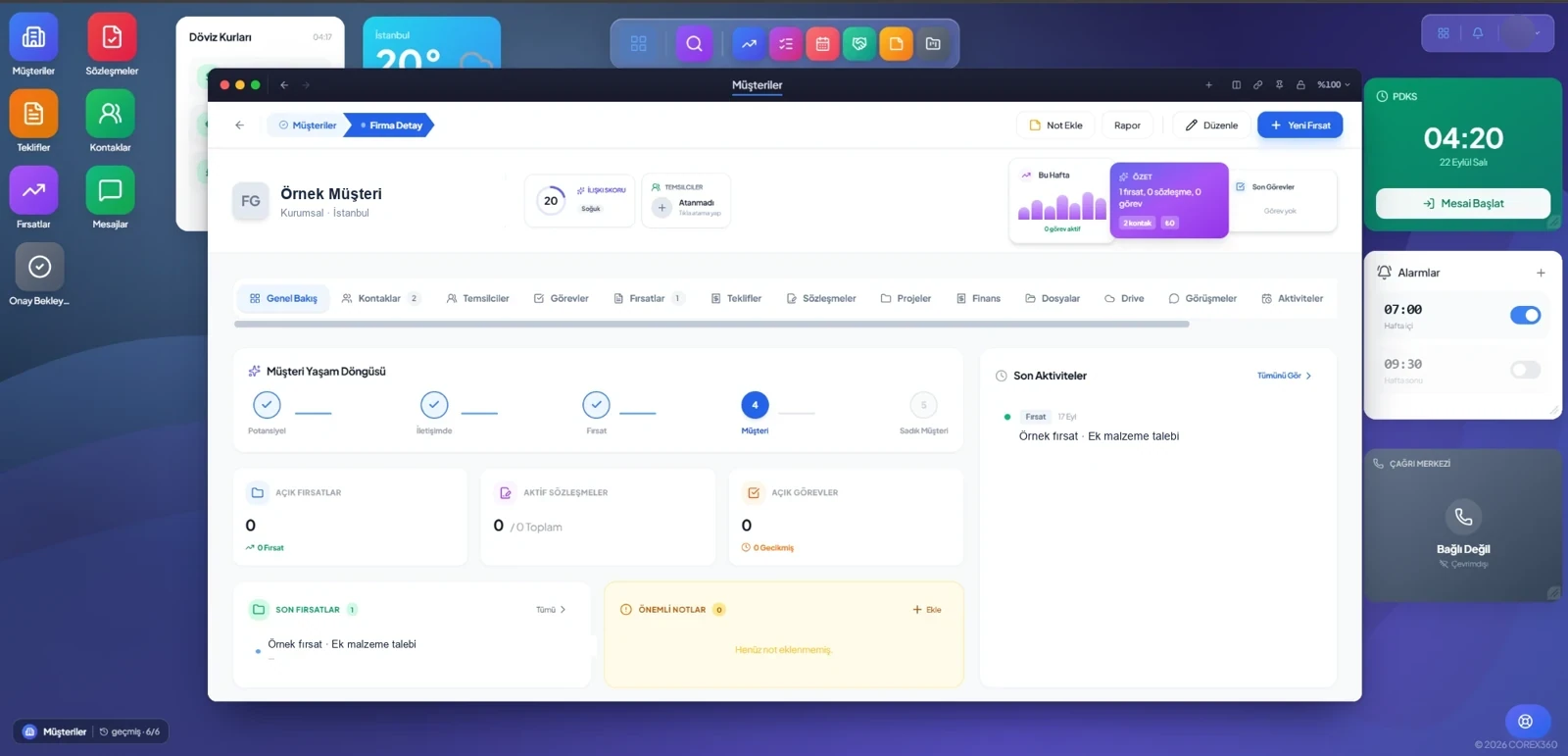
In Corex360 each record opens with the customer lifecycle and a relationship score; the stages are Prospect, In contact, Opportunity, Customer, and Loyal customer, and the card shows where the opportunity came from.
A record opens at the Prospect stage and moves to In contact, Opportunity, Customer, and Loyal customer as the work progresses; the current stage is marked. The source of the opportunity is kept on the record: WhatsApp, the website, email, phone, an office visit, a referral, Instagram, or a site visit, for example. The source criterion of a scoring table can be read from that field. On the customer list an AI Insight card can flag a company as a high-potential opportunity; that flag is a suggestion, and the representative decides whom to call back first. You can see all the tabs of the record on the Corex360 CRM module page.
Sources
How was this page prepared?
- Written by: Şevket Erer, Co-founder, AI Specialist
- Sources: legislation, official body, and vendor information is taken from the primary sources in the Sources list on this page; each source shows the date it was last checked.
- Product information: sentences about Corex360 rest on the company's product fact records; unconfirmed features are not written.
- Use of AI: the Corex360 team writes the text; AI tools are used for drafting and translation. Publishing principles
- Dates: first published . Corrections policy
Frequently asked
01What is lead scoring?
Lead scoring is a method of rating prospects by fit and interest criteria so the sales team knows whom to call back first. The score suggests an order; the salesperson decides who gets a call.
02Which team needs lead scoring?
It is needed once enquiries arrive through several channels in the same week and a salesperson cannot get back to everyone on the same day. If enquiries are few and everyone can be called, a score is not needed.
03How are scoring criteria chosen?
They are chosen by looking at what won and lost deals have in common. Keep the criteria few, and the reason for each should fit in one sentence.
04How quickly does a lead score go stale?
There is no fixed period; the interest score should fade with the time since the last activity. A company that has not written for a long time staying at the top of the list shows that the model has gone stale.
05Is automated scoring a personal data problem?
KVKK Article 11(1)(g) gives a right to object to a result against a person that arises only from automated analysis. That is why the score should stay a suggestion, with a person reviewing the outcome. This answer is not legal advice.
06Does Corex360 have a lead score?
In Corex360 each record opens with the customer lifecycle and a relationship score, and the source of the opportunity is kept on the record. An AI Insight card on the customer list can flag a company as a high-potential opportunity; the representative decides whom to call back first.
Quotes, Contracts, Projects, and Finance are tabs on the same customer card; let us open one of your own customers on that card together.
Related articles
Keep reading.

CRM is software that keeps the customer relationship on one record. In an SME sales day, the customer card, opportunities, quotes, and follow-up work together.
DateRead the article01CRMCustomer tracking in Excel or a CRM: which one, and when
When is Excel enough for tracking customers, and when is it time for a CRM? Weigh the criteria, see the limits of each, and spot the signs early.
DateRead the article02CRMWhat is mobile CRM, and what should the phone in the field show
Mobile CRM opens the customer card, tasks, and approvals on a phone, so the field sees the office record. What to show, app or site, offline, and security.
DateRead the article03CRMCRM migration checklist: moving from Excel step by step
How do you move an Excel customer list into a CRM? Map the columns, remove duplicates, fix phone formats, assign owners, and retire the old file last.
DateRead the article04CRMHow to track sales: from opportunity to quote, and from quote to contract
Sales tracking keeps each opportunity's source, stage, and next step on record. What the card holds, how to spot a stalled deal, and why losses are logged.
DateRead the article05CRMHow to choose a CRM: cloud, own server, one core
Choosing a CRM starts with where you lose customers, not a feature list. A feature you never try with your own card in the demo will not help after setup.
DateRead the article06CRMWhat drives CRM cost: the decisions behind the price table
CRM cost is shaped by users, module scope, hosting, data migration, integrations, setup, and training. Ask the vendor about each of these items separately.
DateRead the article07CRMCRM data migration: exporting, mapping fields, and running both systems for a while
Switching CRM means taking a full export from the old system, mapping its fields to the new one, and running both side by side for a short, planned period.
DateRead the article08