
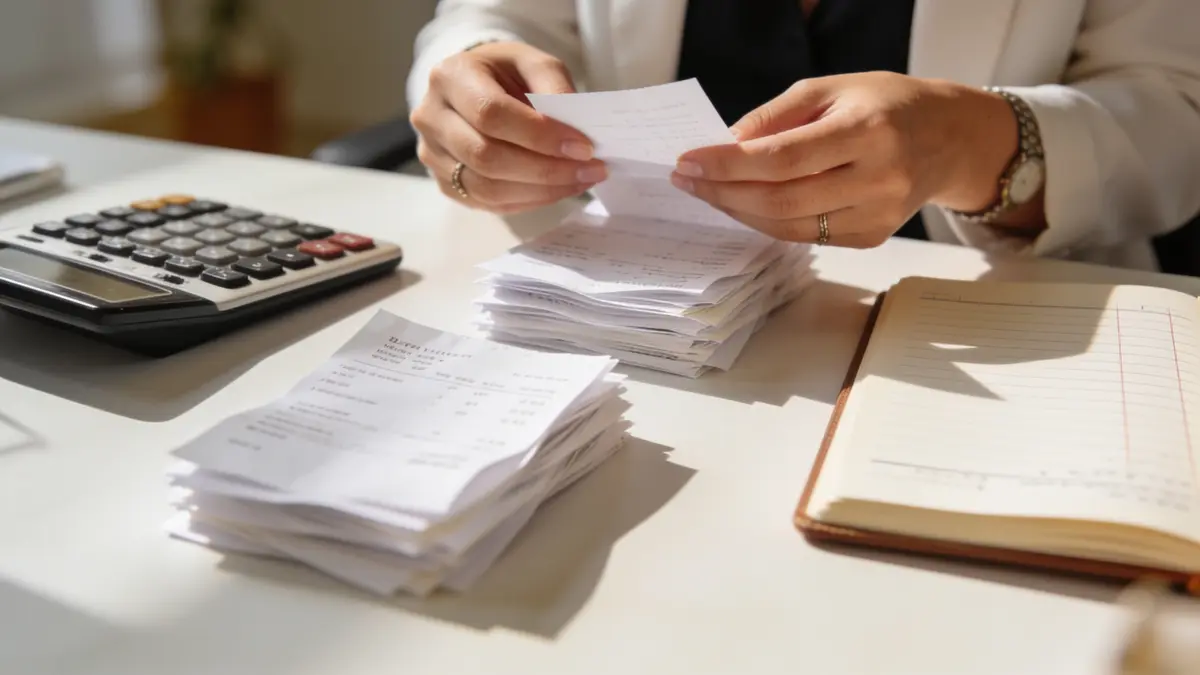
Bookkeeping is the work of recording a business's daily trade in an orderly way before it reaches the official accounts: the invoices it issues and receives, its current accounts with customers and suppliers, its cash and bank movements, and its collections and payments. In most Turkish businesses the official ledgers and tax returns are prepared by an external accountant; bookkeeping produces the raw material for that work inside the business, every day.
01.What does bookkeeping cover?
Bookkeeping covers invoices, current accounts, cash and bank movements, cheques and promissory notes, and collections and payments; in short, it records every moment money enters or leaves the business.
Example scenario: Picture a hardware wholesaler in Bayrampaşa. In the morning, the employee who opens the till counts yesterday's cash sales. At noon a customer sends a bank transfer, which shows up in the bank movements. In the afternoon goods arrive from a supplier and the invoice is left on the desk. In the evening a tradesman leaves a cheque. Each of these is a line of bookkeeping.
- Invoices: sales and purchase invoices, and returns.
- Current accounts: what you owe, what you are owed, and the balance with each customer and supplier.
- Cash and bank: cash in and out, and account movements.
- Cheques and promissory notes: the instruments received and given, with their due dates.
- Collections and payments: who pays you when, and whom you pay when.
Some bookkeeping tools also keep simple stock movements. But the focus is always money: how much came in, how much went out, and who still owes what.
A current account has another side as well. In your books the customer owes one amount; in the customer's own books it may be a different one. Comparing balances with the other party is called reconciliation. When the balances do not agree, the difference is usually a single invoice that one side has recorded and the other has not seen yet. If the bookkeeping is in order, the difference turns up quickly; if not, it gets carried for months.
02.How does bookkeeping differ from formal accounting?
Bookkeeping is the business's own daily record; formal accounting is the work, usually carried out by an external accountant, of turning those records into the statutory ledgers, period-end statements, and tax returns.
At month end the accountant asks the business for its documents: invoices, bank statements, cash records. If the bookkeeping has been kept in order, handing them over is a matter of one folder. If not, month end is spent hunting for missing invoices and trying to remember which customer a bank receipt belongs to.
The distinction has a practical consequence as well. The person keeping the books and the person doing the formal accounts are usually different people, and their communication gets squeezed into month end. The accountant's question ends up relying on one employee's memory. If the records are in order, the question is answered with a document; if not, with a chain of phone calls.
Electronic documents are part of this flow too. Systems such as e-invoice and e-archive invoice change the format and delivery of an invoice; which one is issued depends on your business and your buyer; if the buyer is not registered for e-invoicing or is a final consumer, an e-archive invoice is issued. The Revenue Administration publishes announcements about these systems on its e-document site; for your own case, your accountant is the right person to ask.
03.Where does bookkeeping end and ERP begin?
Bookkeeping records the movement of money; ERP manages the work behind the money, the flow that ties purchasing, stock, production, and shipping together.
| Topic | Bookkeeping | Formal accounting | ERP |
|---|---|---|---|
| Scope | Invoices, current accounts, cash and bank, cheques and notes, collections and payments | Statutory books, period-end statements, and tax returns | The flow that links purchasing, stock, production, and shipping |
| The question it answers | How much came in, how much went out, who owes what? | How do daily records become statutory books and returns? | Why and where did this transaction come from? |
| Who runs it | The business itself, every day | In most businesses, the accountant | A business with a warehouse, purchase approvals, and shipping |
When the same wholesaler grows, the question changes. There is now a second warehouse, purchasing goes through an approval, and shipping depends on a driver's schedule. Bookkeeping software answers the question of how much; ERP answers why and from where. The amount on the invoice is right, but bookkeeping does not know which warehouse the goods left from or which order they belong to.
A third layer sits beside these two: the relationship with the customer. Quotes, contracts, and conversations with the customer do not naturally live in bookkeeping or in a classic ERP. We explained where that layer fits in our article on the difference between CRM and ERP.
04.Where does bookkeeping get stuck?
Bookkeeping gets stuck when the invoice sits in one place and the contract and customer conversation behind it sit somewhere else; accounting has to ask someone else why a record exists.
The first blockage is context. A supplier invoice arrives, and accounting does not know who ordered it, which project it belongs to, or which contract it falls under. It takes an email, a phone call, or a WhatsApp message to find out. The invoice is correct, but on its own it is incomplete.
The second is double entry. Sales prepares the quote in one document, the customer accepts, and accounting retypes the same lines onto the invoice. Every retyping is a fresh chance for a different amount or a forgotten line. The third is proof of payment: the customer says they have paid, and the receipt is sitting on a salesperson's phone.
These blockages have one thing in common: the information exists, but it is somewhere else. The person keeping the books spends part of the day not entering records but chasing missing context. As month end approaches, that chasing speeds up and so does the chance of a mistake.
05.Which one does your business need?
If your activity revolves around invoices, current accounts, and cash, bookkeeping is enough; once stock, purchasing, and shipping depend on each other, you need ERP; if sales and accounting see the same customer from different places, you need a shared record.
- A small product range, simple stock, mostly services: bookkeeping and a steady relationship with an accountant.
- Warehouses, purchase approvals, shipping, or production: an ERP layer.
- The sales contract and the accounting invoice cannot see each other: a shared customer record.
These situations do not exclude each other. An architecture practice or a service company keeps no stock, but it moves between contract, invoice, and customer conversation every day; one worked example is in projects at an architecture practice. What it needs is for sales and accounting to look at the same card; a bigger accounting tool will not do that on its own. Accounting sees the contract while approving the invoice, and the salesperson sees the open invoice while preparing a new quote, in the same place.
06.What does the accounting side look like in Corex360?
In Corex360 the contract, the finance record, and the customer conversation sit on the same customer card; how it works with your existing accounting software is decided together at setup.
In Corex360 the contract sales had signed and the invoice accounting sees sit on the same card, and the signed document is tied to the record in Corex Drive. Sales and accounting see each other, and the question of which contract an invoice belongs to disappears. An invoice arriving by email is recognised by X AI and routed to accounting; access is role-based and logged.
An example: an architecture practice in Kartal receives an invoice from a print shop. If the record says which project's presentation it was issued for and which contract it belongs to, the person in accounting approves it without asking anyone.
The official ledgers, tax returns, and electronic documents are your accountant's job; that is exactly why the line between pre-accounting and official bookkeeping exists. You can see how the accounting team's day runs in Corex360 on the accounting and HR page.
Sources
- Revenue Administration, about e-invoicing Last checked
How was this page prepared?
- Written by: Şevket Erer, Co-founder, AI Specialist
- Sources: legislation, official body, and vendor information is taken from the primary sources in the Sources list on this page; each source shows the date it was last checked.
- Product information: sentences about Corex360 rest on the company's product fact records; unconfirmed features are not written.
- Use of AI: the Corex360 team writes the text; AI tools are used for drafting and translation. Publishing principles
- Dates: first published , last updated . Corrections policy
Frequently asked
01What is bookkeeping?
Bookkeeping is a business's orderly recording of its invoices, current accounts, cash and bank movements, cheques and notes, and collections and payments before they reach the official accounts.
02Does bookkeeping require accounting training?
The basic routine is quick to learn: record every document the same day, keep the document, and check the till and the bank daily. Interpreting a record for tax and regulation is the accountant's field; any entry you are unsure of goes to them.
03What is the difference between a delivery note and an invoice?
A delivery note documents that goods moved from one place to another; an invoice documents the sale and its price. In bookkeeping the two are matched so that no goods are shipped without being invoiced. Ask your accountant which document is required in which case.
04Who is an e-archive invoice issued to?
An e-archive invoice is issued to buyers who are not registered for e-invoicing and to final consumers; if the buyer is registered, an e-invoice is issued. Confirm with your accountant which system applies to you.
05Why are cash and bank movements tracked separately?
Cash and a bank account produce different evidence: bank movements have a statement, cash does not. Tracked separately, the till can be checked against a count and the bank against its statement when the day closes.
06Where do invoices and contracts sit in Corex360?
In Corex360 the contract sales had signed sits in the Contracts tab of the customer card and the finance record in the Finance tab; once company email is connected, X AI reads incoming email and matches the sender to the card. The official ledgers and tax returns are your accountant's job.
The accounting module issues sales and purchase invoices on the same core as the customer card; let us trace one of your own jobs from quote to invoice together.
Related articles
Keep reading.
When choosing bookkeeping software, weigh e-invoicing, customer accounts, cash and bank, data sharing with your accountant, and the link to sales.
DateRead the article01AccountingCollections tracking: how an overdue receivable becomes visible
Collections tracking follows due dates and open balances by customer. If an overdue receivable never reaches the sales screen, nobody makes the call.
DateRead the article02ERPWhat is ERP? What it does and does not do for a small business
ERP is software that keeps purchasing, stock, invoicing, and payroll records in one database. In a small business it stops double entry, but not every problem.
DateRead the article03ERPInventory management software versus ERP: where the difference lies
Inventory software tracks what comes in, goes out, and remains; ERP ties each movement to orders, invoices, and cost. A few signs show which one you need.
DateRead the article04ERPWhat is ecommerce ERP integration: how an order comes off stock
Ecommerce ERP integration carries orders into the ERP and stock and prices to the store. Without it, an overnight order does not come off stock on time.
DateRead the article05ERPWhat drives ERP cost: the items behind the quote
ERP cost comes from the licence model, user and module scope, hosting, data migration, integration, training, and maintenance. Compare quotes item by item.
DateRead the article06ERPHow to choose ERP software: scope, data, and deployment
Choosing ERP software starts with the data you type twice today. Module scope, cloud or own server, accounting set-up, data migration, and the demo.
DateRead the article07CRMWhat is CRM? What an SME sales team expects from it
CRM is software that keeps the customer relationship on one record. In an SME sales day, the customer card, opportunities, quotes, and follow-up work together.
DateRead the article08