

A quote revision is a change to the price, scope, or terms of a quote already sent to a customer, sent again as a new version. Managing revisions means keeping on record, at any moment, which version is valid, what changed between two versions and why, and who approved the change. The trouble usually comes from the old version left lying around.
01.What is a quote revision?
A quote revision is a new version of a quote that replaces one already sent, with its link to the previous version written on the record.
Revisions arise for three reasons: the customer changes the scope, there is haggling over price or discount, or delivery and payment terms are discussed again. Each touches a different part of the quote. A scope change rewrites the line items, haggling changes the amount, and a change of terms rewrites the conditions at the foot of the quote.
Not every change is a revision. If the customer asks for a price for another branch or a separate project, that is a new quote with its own number. A revision is the continuing negotiation of the same job with the same customer. Without this distinction, unrelated jobs pile up under one quote number and it becomes unclear which job a won quote belongs to.
Preparing the first quote is a separate job; the validity period and the basic fields of a quote are the subject of the article on how to prepare a quote. Revision is the order of the changes that happen during that first quote's life.
02.What happens to the old quote once a revised one is sent?
An offer made with a time limit binds the sender until that time runs out; so a revised quote should say plainly that it replaces the previous version.
Under Article 3 of the Turkish Code of Obligations, a person who proposes a contract and sets a time limit for acceptance is bound by the offer until that time runs out. If no time limit is set, Articles 4 and 5 apply: between parties who are present, an offer not accepted at once does not bind, and between parties who are not present it binds until a reply could be expected to arrive. If you send a revision that raises the price while a quote with a stated validity period is still running, a customer who tries to accept the first quote creates a situation that needs a conversation.
So a revised quote carries one sentence saying which version it replaces and that the earlier one is no longer valid. A record showing that the other side has read this, an email or a message, is kept with the quote. This article is not legal advice; ask your legal adviser about the wording of your quotes.
03.How can you tell which version is valid?
The valid version is recognised by a revision mark added to the quote number, the version date, and only one version staying open on the record.
The simplest scheme keeps the quote number fixed and adds a revision mark at the end: the first send is A, then B, C, and so on. The customer and the salesperson talk about the same job with the same number. Words like final, new, or corrected are not used in file names; they lose their meaning by the third revision.
| Field | Why it is needed | Example |
|---|---|---|
| Quote number and revision mark | Tells the version under discussion apart at a glance | Same number, Rev. C |
| Version date | Shows the day the validity period runs from | The day the revision was sent |
| Summary of changes | Saves the customer comparing two documents line by line | Installation item removed, payment term changed |
| Replacement sentence | Closes the validity of the old version | This quote replaces version Rev. B |
| Approved by | Records who owns a discount or a change of terms | Sales manager's approval |
04.What mistakes are most common in revisions?
The most common mistakes are the old version staying valid with the customer, the reason for a change not being written down, and a discount that needs approval going out without it.
- Two versions stay open at once and the customer orders against the old one.
- The revision is written in the body of an email and the quote document is not updated.
- The price is lowered without saying which line it came off, so the next round of haggling starts from scratch.
- A salesperson gives a discount above their authority, and it is noticed only on the invoice.
- Revisions stay on different salespeople's computers and disappear with whoever leaves the team.
Example scenario: picture a quote from a furniture maker in Kayseri for a hotel. The hotel first reduces the number of rooms, then changes the fabric, and finally discusses the payment term. If each step goes out as a separate email attachment, on the day of the order the production team searches three documents to find which fabric to use. On a quote that moves forward on one record, with the same number and a revision mark, the latest version is found at a glance.
05.When should a revision wait for approval?
Revisions that lower the amount, change payment or delivery terms, or narrow the scope while keeping the price should go to an authorised person for approval before they are sent.
Putting every revision through approval slows sales down; putting none through leaves the margin to the salesperson's bargaining. The practical answer is to tie the approval rule to the type of change. Corrections such as a typo or a delivery address go straight out; a discount, a payment term, or a change of scope goes through a manager. When the rule is written down, the salesperson knows when they can answer the customer at once.
The value of approval shows when you look back later. A record showing in which revision the discount grew on a low-margin job, who approved it, and what the customer gave in return strengthens the salesperson's hand in the next negotiation. If approval stays only in email, that trail scatters; it should be tied to the quote's own record.
06.How is a revised quote kept in Corex360?
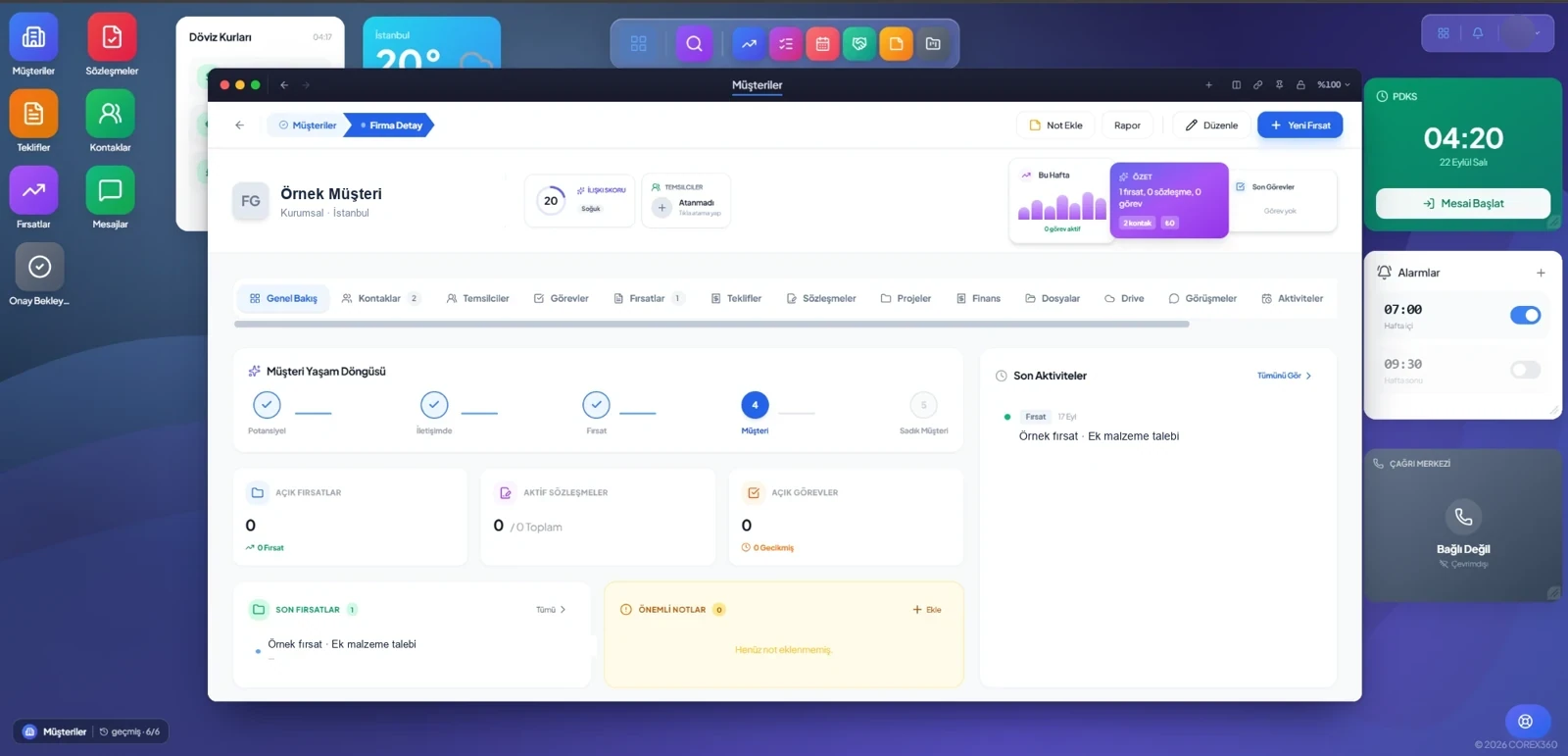
Corex360 keeps quote versions; a revised quote stays on the record together with the previous version, and the quote is followed on the Quotes tab of the customer card.
A quote is built from a template on the opportunity card: product, quantity, price list, and terms are the template's fields. If approval is needed, the quote goes through an approval step, and once it is sent to the customer that stage is recorded. A revised quote stays on the record together with the previous version; quote and contract sit side by side on the Quotes and Contracts tabs of the same customer card. You can look at the whole record on the Corex360 CRM page; the article on quote follow-up covers what to do when a sent quote goes unanswered.
Sources
How was this page prepared?
- Written by: Şevket Erer, Co-founder, AI Specialist
- Sources: legislation, official body, and vendor information is taken from the primary sources in the Sources list on this page; each source shows the date it was last checked.
- Product information: sentences about Corex360 rest on the company's product fact records; unconfirmed features are not written.
- Use of AI: the Corex360 team writes the text; AI tools are used for drafting and translation. Publishing principles
- Dates: first published . Corrections policy
Frequently asked
01What is a quote revision?
A quote revision is a change to the price, scope, or terms of a quote already sent, sent again as a new version. When revisions are managed well, the valid version, the reason for the change, and the approver are on the record.
02Should a revised quote get a new number?
Usually the quote number stays the same and a revision mark is added at the end. That way the customer and the sales team talk about the same job with the same number, and versions are followed in order.
03Is the old quote still valid after a revision?
An offer with a time limit can bind the sender until the time runs out (Turkish Code of Obligations, Art. 3). So a revised quote should state which version it replaces and that the earlier one is no longer valid. This answer is not legal advice.
04Does every revision need a manager's approval?
No; the approval rule is tied to the type of change. Discounts, payment terms, and scope changes go through approval, while typos and address corrections can be sent directly.
05What should the customer be told in a revision?
Give the revision mark, the version date, a short summary of what changed between the two versions, and which version this one replaces. The customer should not have to compare two documents line by line.
06Does Corex360 keep quote versions?
Yes. Corex360 keeps quote versions, and a revised quote stays on the record together with the previous version. A quote is built from a template on the opportunity card and followed on the Quotes tab of the customer card.
A quote is built from a template on the opportunity card, tracked in an approval column, and recorded on the card; let us follow one of your own quotes through that flow.
Related articles
Keep reading.

A quote takes more than a price: scope, validity, approval, and revisions belong on one record. That way the quote holds from question to contract.
DateRead the article01QuotesHow to choose quote tracking software: the criteria behind the decision
Choosing quote tracking software comes down to seeing where quotes get lost after sending. The right option depends on the team, and a demo test shows it.
DateRead the article02QuotesPreparing quotes with AI: the machine drafts, you decide
Preparing quotes with AI means drafting from the record and leaving price, discount, and sending to human approval. What it does, what it does not, what data.
DateRead the article03QuotesWhat is quote follow-up, and why do quotes go unanswered
Quote follow-up means chasing the answer to a quote you sent. When the reminder is nobody's job, the quote goes cold; on the record, follow-up has an owner.
DateRead the article04CRMHow to choose a CRM: cloud, own server, one core
Choosing a CRM starts with where you lose customers, not a feature list. A feature you never try with your own card in the demo will not help after setup.
DateRead the article05Customer trackingHow to track customers: what belongs on the card
Customer tracking means the conversation and next step sit on the customer card. If customers leave with the salesperson, tracking lived in one person.
DateRead the article06IndustryDealer network management: how a dealer's request reaches head office
Dealer network management runs requests, quotes, orders, prices, and support between head office and dealers on one record, so no request drops out of sight.
DateRead the article07IndustryCustomer tracking in showroom sales: from visit to quote
Customer tracking in showroom sales keeps the talk that starts in the store going on one record after the visitor leaves, so a hesitant buyer is not lost.
DateRead the article08